The coupling library for
partitioned multi-physics.
preCICE is an open-source coupling library and ecosystem for general partitioned multi-physics and multi-scale simulations, including surface and volume coupling. Partitioned means that preCICE couples existing programs/solvers capable of simulating a subpart of the complete physics involved in a simulation. This allows for the high flexibility that is needed to keep a decent time-to-solution for complex coupled problems. The software offers convenient methods for transient equation coupling, communication, time interpolation, and data mapping.
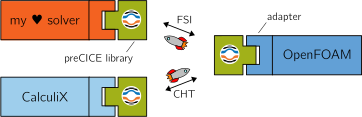
Prepared for the next generation of multi-physics simulations

Minimally invasive integration
- Elegant library approach
- High-level API in C++, C, Fortran, Python, Matlab

Coupling of arbitrary many programs
- Arbitrary combinations of strong and weak interactions
- Arbitrary many solvers

State-of-the-art numerical methods
- Robust quasi-Newton acceleration
- Radial-basis function data mapping

Scalability up to complete supercomputers
- Pure peer-to-peer approach
- Support of heterogenous hardware (CPU/GPU)
- Efficient also on a laptop
Ready-to-use with your favourite open-source solver
Several free and proprietary codes are currently coupled with preCICE. Pick one of our official adapters below or check out our community projects.





What our community is saying
Kyle Davis
University of the Free State, South Africa
Derek Risseeuw
TU Delft, The Netherlands
Marta Camps Santasmasas
The University of Manchester, UK
Academic at heart, 100% free software
Academic at heart
preCICE has been developed by three generations of doctoral candidates from the Chair of Scientific Computing at the Technical University of Munich and from the Institute for Parallel and Distributed Systems at the University of Stuttgart. More information.
100% free software
Licensed under LGPL-3.0, preCICE ensures you retain control of your simulation stack. No license fees, no vendor lock-in, just pure open innovation. You can cite the preCICE library using the paper below. Find more references in our literature guide.


preCICE v2: A sustainable and user-friendly coupling library
Join the Community!
We develop everything in the open, with continuous feedback by a vivid community. Be part of it:
- Ask for help and help others in the preCICE forum and register to receive news.
- Directly edit the documentation. We review and help — nothing can go wrong.
- Report issues on GitHub and help us solve them for everyone.
- Contribute code and simulation examples — we help you with guidelines, tools, and reviews.
- Meet the community in one of the preCICE workshops and conference sessions.
- Subscribe to our quarterly newsletter including:
- New publications
- New features
- New adapters, bindings, tools, tutorials, and more
- Upcoming events and news from the community
You support preCICE — preCICE supports you
As the developers of preCICE, we enjoy supporting our academic and industry users, but due to the growing demand, we are not able to service all support requests anymore. We are introducing preCICE support as a way to contribute to sustainable open-source software development and to ensure preCICE is developed and maintained in the future. Supporting preCICE comes with several benefits:
- Increased success rate for your research proposal (include preCICE as a partner, software provider, or sub-contractor)
- Priority support and direct access to the preCICE developers
- Private, on-site support and bespoke training
We offer different levels of support for industry and academia.
Support preCICE — see options
Frequently asked questions (FAQ)
Can preCICE be used for volume coupling?
Yes. In preCICE v3 there have been many changes and improvements regarding large meshes. The following has ...
Learn moreWhat are best practices to write a new adapter?
There are guidelines for adapters, as well as for application cases, as part of the ecosystem standardization ...
Learn moreCan preCICE be used for one-way coupling?
Yes! Several people are doing this already. Even though there may be other ways to do one-way coupling, it may ...
Learn moreTried and tested by a global community
Through the community-driven development approach, preCICE has become one of the leading coupling libraries for multi-physics simulations both in academia and industry. The wide variety of application fields ranges from aerodynamics to astronautics, automotive manufacturing, wind energy, biomechanics, biomimetics, marine engineering, nuclear fusion, reactor safety, geophysical systems, and many more.

Oden Institute
USA

CIRA
Italy

Fluid Mechanics
Germany

Applied Mechanics
Germany

Scientific Computing
Germany

University of the Free State
South Africa

A*STAR
Singapore

NRG
Netherlands

Helicopter Technology
Germany
FNB
Germany
IWS
Germany

Wind Energy
Netherlands

FAST
Germany

Noise & Vibration
Belgium

Aerodynamics
United Kingdom

MTU Aero Engines
Germany
STS
Germany
Aerodynamics
Netherlands

Heat and Mass Transfer TC
Spain

IFL
Germany

DHCAE
Germany

EuroCFD
France

Global Research for Safety
Germany

MPI-IPP
Germany

CFD & FSI
United Kingdom

Bitron
Italy

AIT
Austria

Fluid Mechanics
Luxembourg

University of Split
Croatia

IIT
India

Nuclear Engineering
Sweden
IAG
Germany

Pprime Institute
France

Corvid Technologies
USA

Space Transportation System Laboratory
Japan

Aeroacoustics and Flow Physics
USA

ATA Engineering
USA

Korea Atomic Energy Research Institute
South Korea

Energy Technology
Netherlands

Computational Fluid Dynamics
United Kingdom

Mechanical and Materials Engineering
Ireland

High Performance Computing
Germany

Alfred Wegener Institute
Germany

Atmospheric Chemistry and Climate Modeling
China
Fluid Mechanics
Germany

Propellant Management
Germany

Paul Scherrer Institut
Switzerland

Model-Based Development
Germany

Ben-Gurion University
Israel

Leibniz Institute for Crystal Growth
Germany

Parallel CFD & Optimization Unit
Greece

Leonardo Labs
Italy
Structural Analysis
Germany

IFPEN
France

Ex Mente Technologies
South Africa

Mintek
South Africa
CardioVascular Biomechanics
Netherlands

Lawrence Livermore National Laboratory
USA

Fusion and Fission Energy
USA

Marine Science and Engineering
China

GeoEnergy Engineering
United Kingdom

Medical Sciences Division
United Kingdom
Computational Electromagnetics
Germany
Structural Mechanics and Dynamics in Aerospace Engineering
Germany

Fixed and Rotary-wing Aircraft Multidisciplinary Eng.
Italy
Rotorcraft Aerodynamic
Italy
Numerical Analysis
Netherlands
How does it look like?
In this tutorial, we couple the CFD code OpenFOAM with a C++ rigid body solver for fluid-structure interaction, using a serial-explicit coupling, as defined in the preCICE configuration file. OpenFOAM loads a ready-to-use adapter, while the C++ code uses the preCICE API. OpenFOAM starts and waits for the other code. After they both start, they find each other and perform a black-box coupled simulation.
